
A practical guide to distinguishing a short riding activity, a trail ride, structured horsemanship training and a genuine riding holiday—and to asking the questions that matter about horses, riders, terrain and welfare before booking.
Horse riding in Sri Lanka can mean very different things. It may be a first encounter with a horse in a controlled setting, a short ride arranged from a coastal hotel, a day on rural trails, a structured training stay or several days built around riding and the care of horses.
None of those forms is automatically superior to the others. A well-run introductory activity can be exactly right for a first-time rider. A short trail ride can be a meaningful experience for someone already staying nearby. A training stay may be more useful than a long itinerary to a rider rebuilding balance or confidence. A riding holiday asks for something else again: continuity, honest screening, appropriate horse–rider matching and enough flexibility to let welfare and field conditions change the plan.
The important question is not whether an experience sounds adventurous. It is whether the product is accurately described, whether it suits the rider, and whether the operator’s decisions remain answerable to the horse.
Begin by identifying the product
Before comparing scenery, accommodation or price, establish what is actually being offered. Four categories are often presented under the same broad language, although they involve different expectations.
An introductory lesson or resort activity
This is usually short and controlled. It can be appropriate for a novice, a family or a traveller for whom riding is one part of a wider holiday. Its integrity depends on being represented honestly. A led walk or introductory session should not be sold as an open-country riding holiday, and a beginner should not be made to feel that speed or distance is the measure of success.
A non-residential trail ride
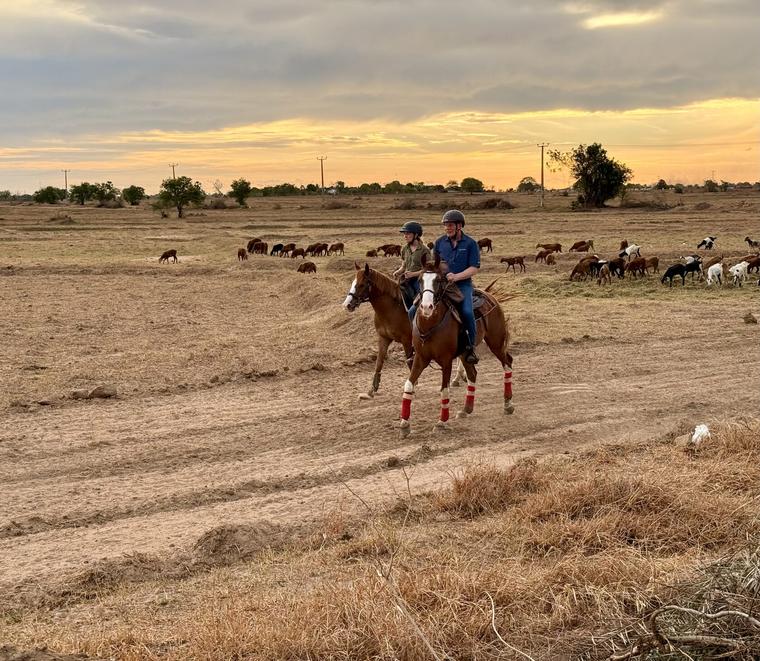
A trail ride is a discrete mounted experience without the accommodation and continuity of a residential stay. The rider may arrive, be briefed and assessed, ride an appropriate route, and leave the same day. Even when it lasts only a few hours, responsible trail access still requires accurate rider information, suitable matching, a clear field authority and the freedom to alter the route or pace.
A structured horsemanship stay
Horsemanship training may include groundwork, handling, stable routines, horse care, riding mechanics and progression into open terrain. Time out of the saddle is not empty time. Watching a horse settle, preparing tack correctly, understanding balance or recognising when to stop asking can be central to the work. A credible programme should explain how learning is shaped around the rider and the horses, rather than promising identical progress to every guest.
A residential riding holiday
A genuine riding holiday is more than accommodation with rides added. The riding, horse allocation, rest, transport, meals, route choices and daily decisions must form a coherent whole. Multi-day riding also makes recovery more important: what was suitable on the first morning may not be suitable after several sessions, a change in weather or an alteration in footing.
The category alone does not establish quality. The useful test is whether the provider is candid about what the experience includes, whom it is for, what can change, and who makes that decision.
Riding labels are not enough
“Beginner,” “intermediate” and “advanced” are convenient words, but they are poor substitutes for evidence. Two riders who choose the same label may have very different balance, confidence, recent experience and exposure to open ground.
A capable rider will often reveal more by describing their last three rides than by selecting a level from a menu. An operator should want to know:
- how recently and how regularly the person rides;
- whether that riding has been in an arena, on roads, across open country or over uneven ground;
- which paces the rider can maintain with independent balance and control;
- whether the rider can mount, dismount and make ordinary equipment adjustments with normal assistance;
- how the rider responds when a horse hesitates, becomes more forward or is separated from another horse;
- whether injury, mobility, confidence, age or current body weight affects matching or the intended route.
There is no embarrassment in being rusty, cautious or new. The problem begins when a flattering label is allowed to replace an honest description. Understatement gives an operator room to choose well; exaggeration can put the rider, horse and rest of the party into a situation that should never have been created.
A thoughtful provider may redirect a novice towards training, ask an experienced arena rider to begin in a controlled area, or decide that a particular route is not appropriate. That is not poor service. It is evidence that access is being considered rather than sold automatically.
Ask what can change for the horse
Almost every equestrian tourism provider says that its horses are cared for. The more revealing questions are operational: what does the operator do when the horse, rider or day no longer supports the advertised plan?
Ask who chooses the horse and what information informs that choice. Ask whether the allocation can change after the rider is observed. Ask how workload, rest, recovery, behaviour, tack, footing, heat and weather influence the decision to ride. Most importantly, ask who has authority to shorten, reroute, postpone or stop the session.
These questions move welfare out of the language of affection and into the structure of the operation. A horse can be clean and photogenic and still be wrongly matched, overused or asked to continue when its behaviour or recovery says otherwise. Conversely, a change of horse or cancelled route need not indicate failure. It may show that someone is still paying attention.
International guidance provides useful reference points without replacing local competence. World Horse Welfare’s responsible-tourism guidance asks travellers to notice condition, soundness, load and equipment, and to use judgement rather than participate in poor practice. The International Society for Equitation Science’s training principles address horse and human safety, equine behaviour and the avoidance of pain, distress and confusion. Those principles become meaningful only when they are visible in ordinary decisions.

In tropical conditions, the itinerary must remain conditional
Sri Lanka should not be treated as one uniform riding environment. Conditions vary by region, season, route and hour. Heat, humidity, shade, wind, recent rain, surface firmness, exposed roots, loose ground, water access, vegetation, wildlife movement and daylight can interact with the individual horse and rider.
That is why a single national heat number or a promise that a named route always proceeds can create false confidence. A familiar track can ride differently after rain. A horse that recovered promptly on one day may require a lighter plan on another. A rider who is competent in a cool arena may use energy differently in open tropical conditions.
A serious operator should be able to explain the day’s decision, but should not pretend to remove uncertainty. Departure time, route, pace, distance, horse allocation and the decision to proceed should remain open to review. Weather information matters; so do the horse’s behaviour, breathing, gait, willingness, hydration and recovery. This is field judgement, not theatre around a fixed itinerary.
Vonfidel Ranch’s open Responsible Equestrian Tourism in Tropical Conditions field brief sets out this approach in more detail and links it to published welfare, training and adventure-tourism guidance. It is a practitioner document, not a certification, veterinary protocol or peer-reviewed study. That limitation is part of its usefulness: it distinguishes operating judgement from claims the evidence cannot support.
What should be clear before a booking
A proper pre-booking exchange should reduce ambiguity for both sides. Before money is committed, the rider should understand the kind of product being offered and the operator should understand the people asking to take part.
The exchange should establish:
- Who is travelling. Every rider and non-riding companion should be declared, together with recent riding experience and any information relevant to participation.
- Which pathway fits. The operator should assess whether the request belongs in an introductory, training, trail or residential format rather than forcing every enquiry into the most expensive product.
- What is included. Riding scope, accommodation, meals, local transport, equipment and material exclusions should be stated clearly enough to compare the offer with the traveller’s assumptions.
- What remains conditional. The rider should know which elements may change because of horses, suitability, weather, footing or operating conditions.
- When confirmation occurs. A submitted form or friendly conversation is not necessarily a booking. The point at which access, price and terms become confirmed should be unambiguous.
- Which terms govern a change. Cancellation, insurance expectations, assessment outcomes and any material conditions should be available before commitment, not introduced after a problem arises.
A polished itinerary cannot compensate for a vague agreement. Clarity before arrival protects the rider’s expectations and gives the operator room to make responsible decisions without appearing to rewrite the product mid-stay.
Ten questions to ask any riding operator
Use these questions before choosing a horse-riding experience in Sri Lanka or elsewhere:
- What kind of riding product is this: an introductory activity, trail ride, training programme or residential riding holiday?
- What recent riding information do you need from every rider?
- Who decides whether I am suitable and which horse I ride?
- Will you observe me in a controlled setting before open-country riding?
- What is the maximum party size for this particular programme?
- What can change because of the horse, rider, ground or weather?
- How are workload, rest and recovery considered across several riding days?
- What equipment is provided, and what must I bring myself?
- Exactly what is included and excluded from the written price?
- When is the booking confirmed, and which terms apply if the plan changes or participation is stopped?
The quality of the answer matters more than its length. A provider may not disclose every internal record or procedure, but should be able to explain its standard plainly. Evasion, pressure to pay before material questions are answered, or a guarantee that horses and routes never change should prompt further scrutiny.

How Vonfidel Ranch applies the distinction
Vonfidel Ranch is a working equestrian estate at Punanai in Batticaloa District, in Sri Lanka’s Eastern Province. It offers three separate access paths rather than presenting every request as the same product.
Signature Riding Holidays are private residential programmes for riders who meet the current experience standard. Trail Rides are limited non-residential access for suitable riders staying nearby or based in Sri Lanka. Horsemanship Training Holidays combine riding with handling, observation, care and practical development; they are also the pathway through which beginner and novice riders may be considered.
The controlling document is the Ranch’s current Standard of Access. It explains the applicable rider requirements, party limits, suitability review and field authority. Access is considered before confirmation. Horse allocation, route, pace, timing, duration and even the decision to ride can change when welfare, suitability or conditions require it.
That format will not suit everyone. The Ranch is intentionally low-volume, does not offer casual walk-in riding, and does not treat an enquiry as automatic access. Riders seeking instant confirmation, a guaranteed horse or an itinerary that cannot change may prefer a different form of experience. The purpose of stating that boundary is not exclusivity; it is to prevent the wrong expectation from becoming the horse’s problem.
Choose the operation, not the adjectives
Words such as “authentic,” “ethical” and “welfare-first” are easy to place on a page. A rider should look for the decisions underneath them.
Can the operator describe its product without blurring the categories? Does it ask enough to understand the rider? Can it explain how horses are matched and rested? Is someone clearly authorised to change the plan? Are the commercial terms as legible as the scenery? Does the operation remain credible when the answer is no, not today, or not with that horse?
Good riding is not proved by the longest route or the fastest pace. It is found in the quality of the match, the attention given before and after the ride, and the judgement to proceed only while the horse, rider and conditions remain in agreement.
About the author
Alfie Ameer is the founder, equestrian lead and field operator at Vonfidel Ranch. He leads or personally supervises the Ranch’s riding experiences and holds final equestrian judgement over horse–rider matching, horse allocation, routes, pace, field conditions and whether a ride proceeds or changes. Author profile.
Further reading
Last reviewed: 17 August 2026
Corrections: Factual corrections may be sent to info@vonfidel.com.
Corrections: Factual corrections may be sent to info@vonfidel.com.