
01Open field brief
Eastern Sri Lanka
Version 1.0
Responsible equestrian tourism in tropical conditions.
A practical framework for putting horse welfare, participant safety, terrain, and changing weather ahead of a fixed itinerary. The brief connects published international guidance with the day-to-day judgment a low-volume equestrian operation actually exercises.
Field evidence
The brief describes decisions taken in this country, on this ground.
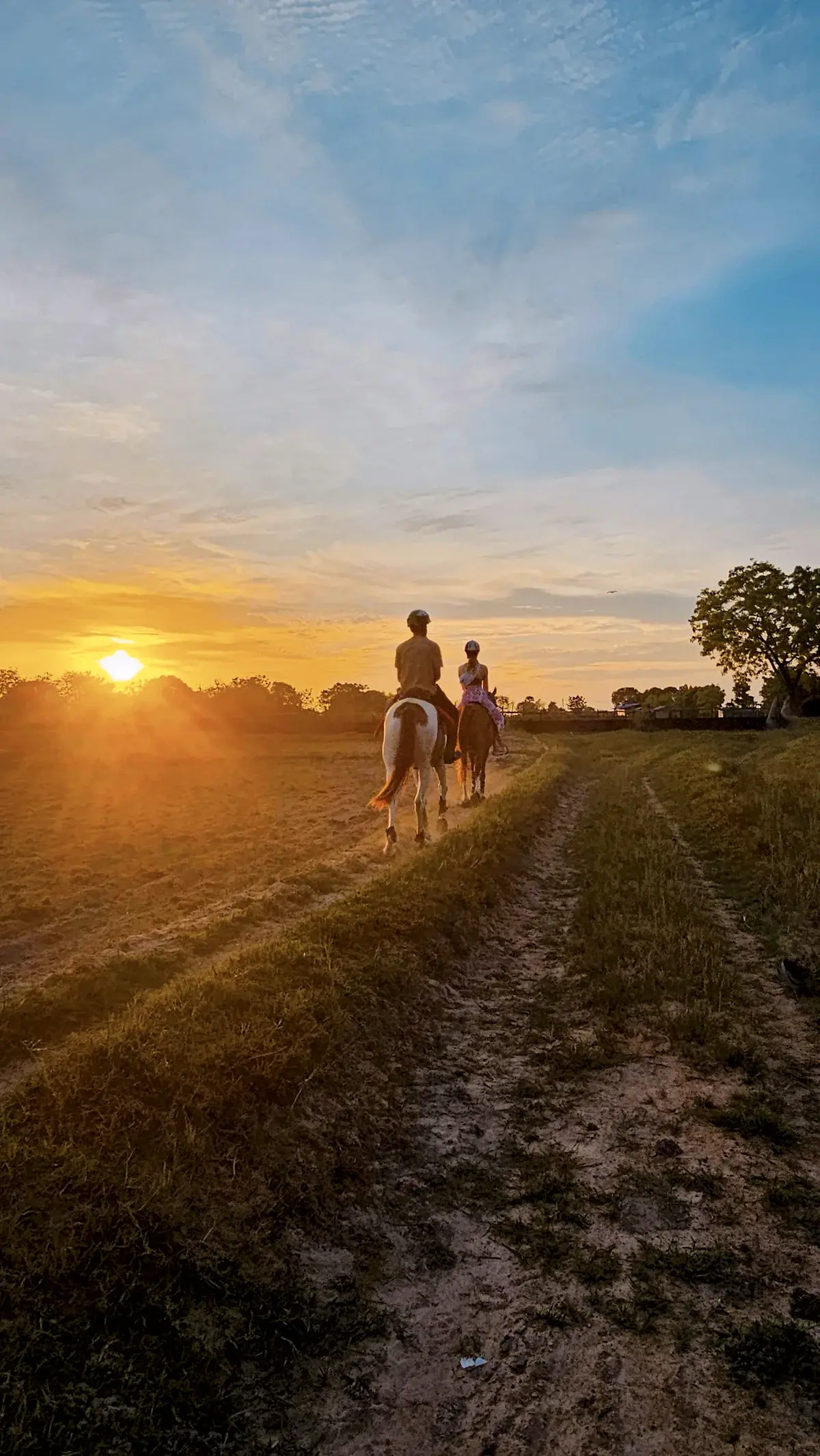
Responsible riding begins with the decision to adjust, shorten, or cancel when the horse, rider, route, or weather does not support the plan.
The premise
02Executive summary
The itinerary is conditional. The responsibility is not.
Five positions this brief takes.
Horse-first decisions
Fitness, behavior, recovery, and willingness are assessed before commercial promises or guest expectations.
Dynamic risk management
Rider, horse, route, footing, heat, humidity, wildlife movement, and recent rain are considered as one changing system.
No universal heat number
Local weather data matters, but individual horses and field signs determine whether work is reduced or stopped.
Low volume as a control
Limited access protects attention, horse rotation, and the ability to change a plan without pressure to preserve throughput.
Traceable judgment
Briefings, go and no-go decisions, route changes, and welfare observations are recorded well enough to support learning and accountability.
03Go or no-go
A scheduled ride is not an entitlement.
The plan proceeds only when horse, rider, personnel, route, and weather align.
The commercial cost of changing the plan does not outweigh the horse's welfare or participant safety. That is the whole of the standard, and everything below is how it is applied.
- Changes in behavior, breathing, gait, willingness, recovery, or hydration.
- Footing altered by rain, drying ground, loose gravel, exposed roots, or erosion.
- Heat and humidity read against the individual horse, not against a published number.
- A rider, a party, or a request that the available horses cannot carry.
04Seven operating principles
A field translation of international guidance. Not certification criteria, not universal thresholds, and not a substitute for veterinary or legal advice.
A usable standard begins before the saddle.
Start with a go or no-go decision
A scheduled ride is not an entitlement. The plan proceeds only when horse, rider, personnel, route, and weather align.
Match the whole system
Rider balance and experience are considered alongside the individual horse, the terrain, the expected pace, and the exposure.
Read the horse, not only the forecast
Heat and humidity raise risk, but behavior, breathing, recovery, hydration, gait, and willingness provide the immediate field evidence.
Build in water, shade, and recovery
Timing, distance, and rest opportunities are planned before departure, with enough flexibility to shorten or stop.
Reassess footing after change
Rain, drying ground, loose gravel, exposed roots, and erosion can alter a familiar route. Yesterday's route is not automatically today's route.
Use calm, legible handling
Horse and human safety depend on appropriate matching, clear signals, humane equipment, and the avoidance of pain, fear, and confusion.
Record and review
Near misses, route changes, welfare observations, and cancellations are treated as operational evidence, not as inconveniences to hide.
05Guidance into practice
International sources address different scopes. None replaces local competence.
Published principles matter only when they change decisions.
Adventure-tourism safety is managed as a system, not as an isolated waiver or briefing.
Define responsibility, assess changing risks, prepare for incidents, and review what happened.
Route assessment, rider declaration, briefing record, emergency contacts, incident and near-miss log.
Horse welfare is assessed through outcomes including behavior, physical condition, lameness, and fitness for work.
Observe the horse before, during, and after work. Change or stop the plan when the animal is not fit or willing.
Horse allocation and rotation notes, condition observations, recovery notes, farriery and care records.
Training should protect human and horse safety, respect equine behavior, and avoid pain, distress, and confusion.
Match horse and rider carefully, use clear cues, and do not turn a guest ride into a forced training session.
Suitability review, horse profile, tack check, and a documented reason for reassignment or refusal.
Responsible tourism asks travelers and operators to examine fitness, load, welfare, and preparedness.
Set expectations before booking, refuse unsuitable requests, and explain why horse welfare changes the itinerary.
Published access standard, pre-arrival questions, written welfare policy, and transparent cancellation terms.
06Tropical conditions
Heat, humidity, and terrain require judgment, not theater.
Why this brief publishes no temperature cut-off.
In Sri Lanka's Eastern Province, riding conditions can change across a single day and between nearby routes. Heat exposure, humidity, shade, wind, recent rain, surface firmness, and access to water all affect the responsible choice.
A single number can create false confidence when workload, acclimatization, the individual horse, route exposure, and recovery capacity all differ. The safer approach is a conservative plan supported by weather information and continuous observation of the horse.
At Vonfidel Ranch this means that departure time, route, pace, distance, horse allocation, and whether a ride proceeds at all remain subject to field authority.
Operational signals
Changes in behavior, breathing, gait, willingness, recovery, or hydration are reasons to reassess. They are not challenges to push through for the sake of a schedule.
07Method and limits
What this document is, and what it is not.
Scope, and the claims this brief does not make.
This is a practitioner field brief. It combines public international guidance with operating observations from a private, appointment-only equestrian facility, and is intended to support discussion among tourism authorities, equestrian operators, educators, travel designers, and researchers.
It has not been peer reviewed, it does not report a controlled study, and it does not claim that Vonfidel Ranch is certified by any organization referenced below. The World Organisation for Animal Health chapter cited here formally excludes leisure horses. It is included because its outcome-based welfare indicators and heat-stress guidance offer a useful comparison, not because the chapter governs leisure riding.
ISO/AWI 25473 is identified correctly as a work item under development and should not be represented as a published certification standard. ISO 21101 is referenced at the level of its public scope. No claim of conformity is made.
Review invitation
Academic, veterinary, tourism, and equestrian organizations are invited to identify omissions or propose sources for the next revision. Write to info@vonfidel.com.
Sources consulted
- 01International Organization for Standardization, ISO 21101:2014, Adventure tourism — Safety management systems — Requirements. The ISO page records the standard as confirmed in 2025.
- 02International Organization for Standardization, ISO/AWI 25473, Adventure tourism — Horse and camel riding. Status: under development.
- 03World Horse Welfare, Responsible Tourism, guidance for travelers encountering horses and other equids in tourism.
- 04International Society for Equitation Science, ISES Training Principles, including horse and human safety, equine behavior, and clear, humane training.
- 05World Organisation for Animal Health, Terrestrial Code Chapter 7.12, outcome-based welfare measures and heat-stress guidance for working equids. Scope limitation noted above.
- 06Fédération Equestre Internationale, Equine Welfare Strategy Action Plan, including training, riding, tack, stress, accountability, and fitness.
08Citation and reuse
Use the brief. Preserve its limits.
Suggested citation: Ameer, A. (2026), Responsible Equestrian Tourism in Tropical Conditions: A Field Brief from Eastern Sri Lanka (Version 1.0). Vonfidel Ranch. https://doi.org/10.5281/zenodo.21740159
The authored text is © 2026 Alfie Ameer and licensed under CC BY 4.0. The Vonfidel Ranch logo and photographs are excluded from that license, all rights reserved. Please do not present the brief as a certification, a veterinary protocol, or peer-reviewed research.
Download the PDF