
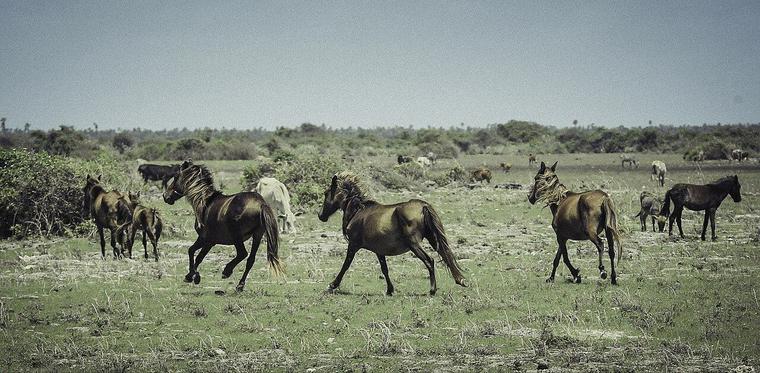
The Government's August 2026 announcement that Delft Island is to be developed as Sri Lanka's first zero-emission eco-tourism destination deserves attention for an obvious reason. Delft is one of the few places in Sri Lanka where horses are not being brought into a tourism proposition. They are already part of the place.
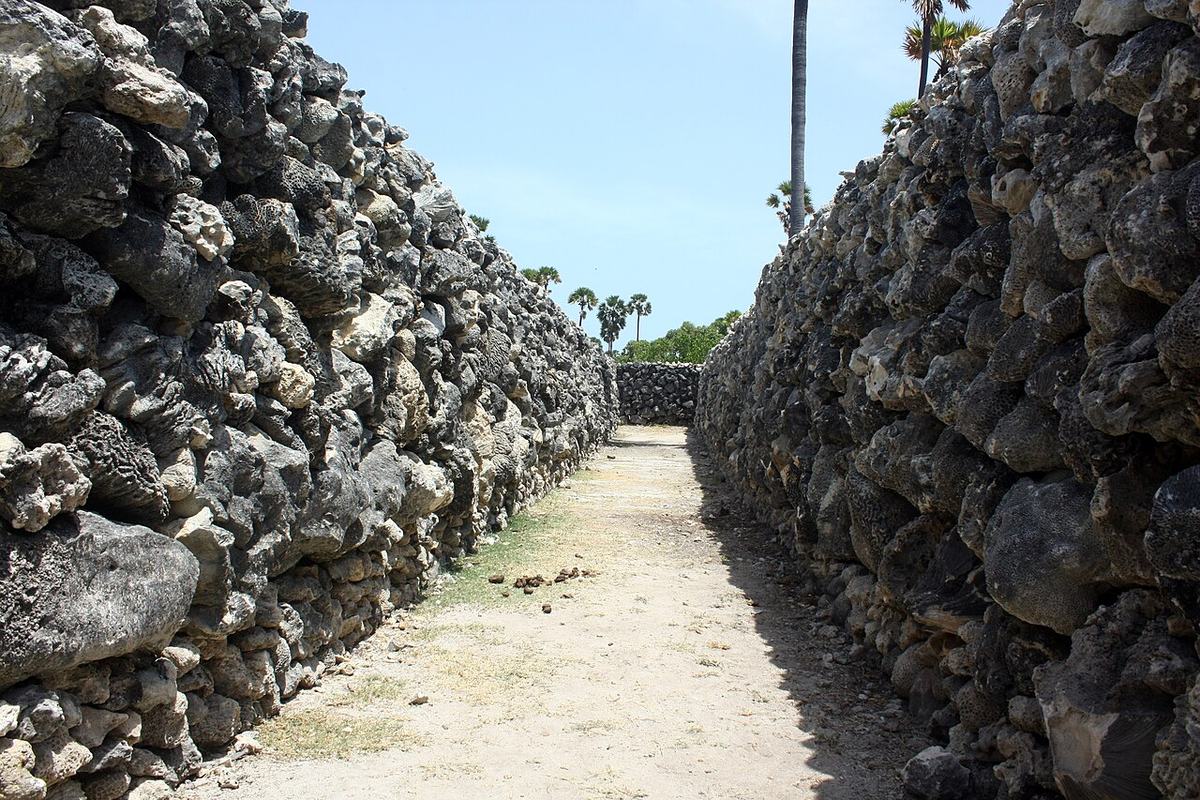
The free-ranging horses, coral walls, palmyrah, old ruins and hard, open ground belong to the same landscape. Remove the horses and something important would be missing.
That makes the proposal worth watching from an equestrian perspective. It is also important to be precise: what has been announced is a development plan. The eventual operating model, safeguards and carrying limits will determine whether its environmental promise is fulfilled.
A landscape with horses already in it
Delft's attraction is partly its distance and difficulty. The country is exposed. Water is finite. History lies in the landscape without always being packaged for the visitor. The horses move through it on their own terms.
They are often called wild horses, although they descend from domestic stock associated with the island's colonial history. Free-ranging is the more careful description. Whatever term one prefers, they have become inseparable from Delft's identity.
Sri Lanka has often treated tourism development as a physical exercise: more rooms, better roads, more vehicles, more restaurants and greater capacity. That can be entirely appropriate in some places. In others, much of the value lies in what has not yet been built. Delft belongs in the second category.
If that character is lost, environmentally efficient infrastructure will not restore it.
Zero emission is only part of the question
Low emissions matter. But a genuinely light tourism footprint concerns more than the source of electricity or the vehicle carrying a visitor. It also concerns water, waste, construction, disturbance, local ownership and the number of people a place can absorb without being reorganized around them.
Delft makes these limits visible because its residents, livestock, horses and visitors depend on the same small island environment. Official and conservation sources have repeatedly identified water as a practical constraint. During dry periods, public authorities fill tanks used by horses and cattle. Dilmah Conservation has also documented the pressure that inadequate drinking water places on island residents and the horse population.
This is not picturesque background. It is part of the operating reality against which any tourism plan must be judged.
The best starting point already exists. An ecological, socioeconomic and archaeological assessment of Delft, published by the Government of Sri Lanka and IUCN in 2013, considered conservation and tourism together. A serious new model should build on that record, publish its current evidence and make its limits inspectable.
What the horse teaches about limits
Anyone who spends enough time traveling in open country on horseback learns that the horse removes some of the illusion that everything can be scheduled.
Heat changes the day. So does water. The ground changes it. A horse that is not right changes it. A rider who is not capable of the planned country changes it. Sometimes the route you intended to ride is simply not the route you ride.
Good horsemanship requires accepting those limits, not continually engineering around them. Good nature-based tourism may require much the same discipline.
That is one reason equestrian travel deserves a place in Sri Lanka's wider discussion about lower-impact tourism. There is a difference between offering horse riding as an activity and traveling through country on horseback. The first can be installed almost anywhere. The second depends completely on where you are.
On a proper journey, the country begins to dictate the experience. You notice where water lies, where shade falls, what the ground is doing under the horse, where villages end and cultivation begins, which tracks still connect one place with another, and how quickly the land can change.
A vehicle is extraordinarily efficient at getting us to a place. Sometimes it is so efficient that we miss the country between places. A horse slows that passage and makes the ground legible.
This should not be presented as environmental absolution. Keeping and traveling with horses carries a footprint. Horses require feed, water, veterinary care and land. Operations require people, equipment and, at times, vehicles. Poorly managed riding can damage ground just as other recreation can.
The case for equestrian travel is not that it is impact-free. It is that, at the right scale and under competent management, it can offer access without requiring a landscape to be heavily rebuilt around the visitor.
A place cannot be protected as scenery
Sri Lanka has a successful circuit of beaches, wildlife, tea country and ancient cities. There is another layer of the country that is less easily packaged: tank country, jungle margins, village tracks, dry-zone plains, palmyrah country, remote coastline and the old routes between them.
These are not empty spaces between attractions. For a small number of travelers, experiencing them slowly and intelligently can be the attraction itself.
That is where Sri Lankan equestrian travel has a credible future—not as a copy of Rajasthan, Mongolia, Argentina or another established riding destination, but as something particular to this island.
The horses of Delft matter in that discussion because they show that the horse already has a place in Sri Lanka's landscape and history. They also raise an uncomfortable obligation. Once an animal becomes part of the tourism value of a place, it cannot be reduced to scenery. Access to water, grazing pressure, health and habitat cannot sit below the visitor experience in the order of priorities. They are part of the same question.
At Vonfidel Ranch, several hundred kilometers from Delft, our circumstances are different. Our horses are managed horses and our riding country is different country. We have no involvement in the Delft proposal.
The underlying operational problem is nevertheless familiar. How much access is enough? Some routes can take more use and others should not. Some days the weather decides. Some riders are suitable for a particular piece of country and others are not. There are occasions when protecting the horse or the ground means giving up something that might otherwise have made a good day's riding.
Sustainability eventually comes down to decisions of this kind.
Value without volume
The Delft initiative will bring discussion about investment, infrastructure and visitor numbers. It should. Better livelihoods and meaningful authority for the people who live on the island must be part of any credible model.
But Delft may have an opportunity to demonstrate something more demanding than a zero-emission label: that a destination can become more valuable without becoming more built; that access can improve without everything becoming easily accessible; and that the economic value of an unusual landscape can come from protecting its character rather than maximizing the volume of people moving through it.
That would require practical commitments: published water and waste plans; animal-welfare monitoring; community participation with decision-making weight; construction and transport limits; and visitor thresholds that can be tightened when evidence requires it. A low-emission vehicle is useful. It is not a carrying-capacity policy.
Tourism planning tends to ask what else a place needs. Delft may be one of those rare places where the better question is what it does not.
Disclosure. Vonfidel Ranch has no involvement in the Delft proposal. This is an equestrian operator's commentary on the publicly announced plan and the published record concerning Delft's landscape and horses.
Sources and context
Related reading
Image credits. Hero photograph: Gajapera / Wikimedia Commons, CC BY-SA 4.0. Inline photograph: AntanO / Wikimedia Commons, CC BY-SA 4.0. Both images were resized and compressed for web presentation.