
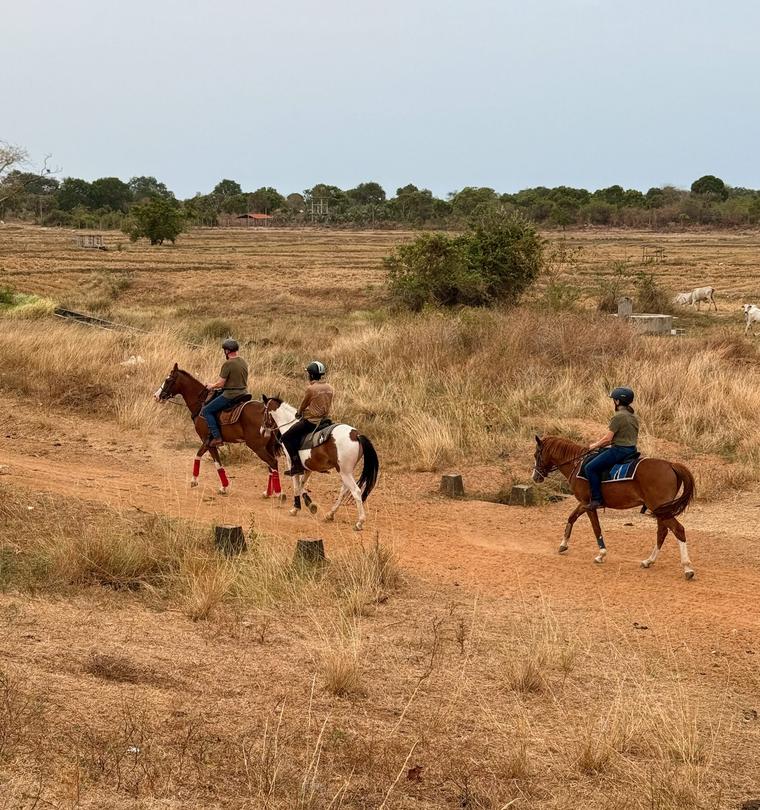
The argument in this essay comes from operating in one part of Sri Lanka's Eastern Province. It offers an operator's account from one area; no national market forecast is implied. The practical observation is that a room can support a rural journey, but it cannot explain why that journey belongs in a particular place.
At Vonfidel Ranch, the reason to travel is found outside the bedroom. It is in Punanai's old tanks and seasonal streams, the dry-zone ground, the people who read that ground through their work, and the horses whose pace makes the country legible. The accommodation matters because a guest needs to sleep, eat, prepare, and recover well. Its value increases when it helps the visitor enter the wider place responsibly.
That relationship between base and experience deserves more attention in rural tourism.
The room is a base
Good rural accommodation is difficult work. Cleanliness, food, maintenance, water, communication, privacy, safety, and reliable service cannot be dismissed as background. They are part of the visitor's confidence in the destination.
The limitation appears when the property becomes the whole proposition. Rooms can be photographed, counted, compared, and discounted. They are therefore easier to develop and market than an experience that depends on weather, local knowledge, permissions, guest readiness, or a living animal.
Rural Sri Lanka has more to offer than a view framed by a window. A well-run stay should help a guest understand what lies beyond the property, while making clear that local life is not scenery arranged for visitors.
Specificity is the asset
Paddy land, tank bunds, scrub, village roads, cattle country, lagoons, coastline, food, craft, history, and religious life do not form one generic rural product. Each area has its own working relationships and limits. The useful question concerns what this place can share honestly and repeatedly.
That answer may be a guided walk, a food experience, a boat journey, cycling, birding, farming knowledge, craft, heritage, conservation work, or horseback travel. It may also be that part of a place should not be commercialized at all.
The strongest experiences are difficult to copy because they depend on people who know the area, timing learned over years, and access maintained through trust. Their identity cannot be supplied by decor.
An experience has to be operated
Natural beauty does not organize a safe day. Someone still has to understand the route, recent weather, transport, food, communications, guest ability, local activity, and what happens if the plan changes. Where horses or wildlife are involved, animal welfare and human judgment become inseparable from the tourism product.
At the Ranch, a route may shift after local reports or reconnaissance. A crossing may be declined when water obscures the bottom. A rider may be matched to a different horse. A ride may close because the margins no longer feel right. The guest experiences a calm decision; the preparation behind it can involve many people and observations.
The same principle applies to other rural experiences. A guide needs more than a memorized commentary. Hosts need enough authority to alter or stop the plan. Emergency arrangements have to be credible. Timings should respect heat, weather, local work, worship, wildlife, and the people whose home is being visited.
This operational layer is where much of the value sits. It separates a well-understood encounter from an activity added to an itinerary because there was an empty afternoon.
Local benefit requires real relationships
Rural tourism is often described as community benefit without explaining how that benefit travels. A credible model should be able to name the relationships involved: who provides knowledge, guiding, food, transport, maintenance, produce, access, or specialist work; who carries risk; and who is paid.
Not every relationship needs to be displayed to the guest. People should not have to perform their daily lives to demonstrate that tourism is local. Their authority over what is shared, photographed, or left private matters.
At Vonfidel Ranch, some of the most useful field information comes through people whose work is tied to the land: cultivators, cattle herders, residents, and officers working across the area. Their observations may change a route without ever becoming part of the guest's story. Respect includes recognizing the value of that knowledge even when it remains behind the scenes.
Scale is a field decision
A place-specific experience cannot always absorb the number of people a property can accommodate. A narrow route, a small craft workshop, a household, a wildlife corridor, or a limited string of suitable horses may set a lower capacity.
That limit should be built into booking and pricing before pressure develops. Seasonal changes may require different timings or temporary closures. Some guests may not be suited to an activity. A responsible operator needs enough commercial confidence to say so.
This does not make rural tourism inaccessible. It makes access intelligible. Visitors know what is expected, hosts know what they have agreed to provide, and the character of the experience is less likely to be consumed by its own popularity.
The work is shared
Public institutions and private operators have different responsibilities. Roads, utilities, environmental protection, training, public safety, destination information, and confidence in standards need coordinated attention. Operators remain responsible for the truth of what they sell and the conduct of the experience on the ground. Residents and local organizations need a real voice in what tourism is allowed to use.
No policy phrase can substitute for this practical division of work. Equally, isolated operators cannot solve every access or infrastructure problem alone. Rural destinations improve when the people setting rules and the people delivering experiences understand one another's constraints.
Better questions for rural development
Before adding another tourism unit, it is worth asking:
• What can a visitor encounter here that belongs specifically to this place?
• Who holds the knowledge needed to interpret it, and on what terms will that knowledge be used?
• What are the operational, welfare, cultural, and environmental limits?
• How will a host change the plan when conditions change?
• Which local businesses and workers participate in the value created?
• What should remain outside the visitor economy?
These questions are harder to answer than a room count. They are also more useful for building a destination people can understand, respect, and recommend for the right reasons.
Rural Sri Lanka needs good rooms. It also needs well-prepared reasons to leave those rooms: encounters rooted in the actual landscape, operated by people with judgment, and limited before the place or its residents have to pay for excess. Accommodation is strongest when it supports that work.
Related reading: Riding Holidays, The Ranch, and Field Note 002: The Things We Measure That Guests Never See.