
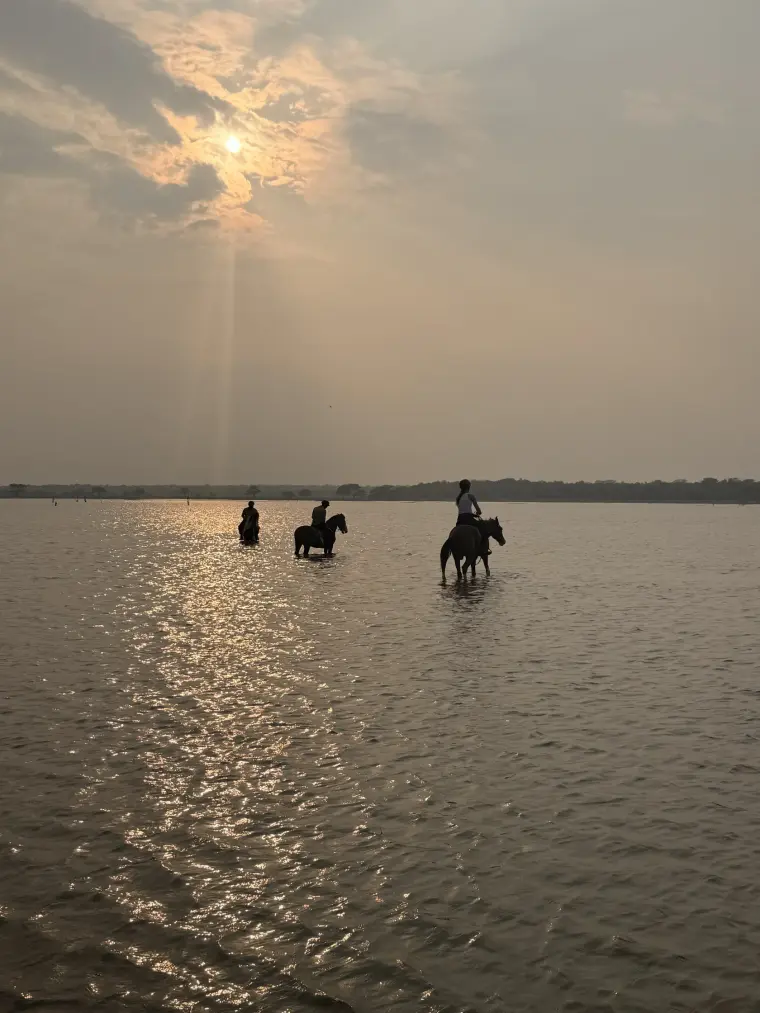
Tourism has changed shape over the last decade. A place is as likely to be found through someone else’s photograph as through any guidebook — an image circles the world in an afternoon, and by evening it has landed on a thousand lists of somewhere to go one day. Several businesses along Sri Lanka’s coast have built themselves around that current, some of them skilfully.
Vonfidel Ranch took its bearings from a narrower question: once someone is actually here, on a horse, what is going to matter to them? Attention and experience turn out to be different projects, pursued in different ways, and the ranch has generally chosen the second.
Most of what shapes a guest’s holiday happens before they arrive. Which horse will suit this particular rider. Whether the rain has changed the footing on a given trail. Whether the day calls for a walk instead of a canter. Whether someone who describes themselves as experienced is picturing a ride they will actually enjoy. This groundwork has nothing to do with photographs, and it keeps mattering long after any photograph has been taken and forgotten.
No two holidays at the ranch begin quite the same way. Before a guest sets foot in a stirrup, someone has usually spent real time understanding what they’ve ridden before, matching them to a horse with some deliberation, and picking a route to suit the ground rather than the light. These decisions are largely invisible to the guest. They are also what the rest of the holiday is built on.
The horses here are not treated as props, and guests are not left with the sense that their holiday exists to generate content for somewhere else. A well-run riding holiday isn’t staged for an audience — it holds together on its own, whether or not anyone is watching. That view shows up in smaller ways too: a trail kept in better condition than any guest will ever know it takes to maintain it, a booking turned down because taking it would come at the expense of everyone already booked.
Little of this is visible from outside. It amounts, mostly, to the unglamorous work of making sure a stay turns out better than a guest expected going in.
Guests tend to register more than they’re given credit for. A horse that stays calm. A pace that doesn’t rush the landscape. A guide who knows when a view doesn’t need explaining. None of this makes for a striking photograph, but it’s usually what brings someone back, and what gets a place mentioned to a friend without any prompting.
An unprompted recommendation carries its own kind of weight — not because it reaches the widest audience, but because no one asked for it. That doesn’t make it a better strategy than a well-run influencer campaign; it simply operates on a much longer timeline, and it’s the timeline Vonfidel Ranch has chosen to work on.
The ranch was never built with the largest possible audience in mind. It was built for people drawn to horses, to horsemanship practised with some care, and to a landscape better taken in at the pace of a walk or a trot than through a lens. Building slowly toward that kind of guest has, so far, seemed the better trade.
Vonfidel Ranch took its bearings from a narrower question: once someone is actually here, on a horse, what is going to matter to them? Attention and experience turn out to be different projects, pursued in different ways, and the ranch has generally chosen the second.
Most of what shapes a guest’s holiday happens before they arrive. Which horse will suit this particular rider. Whether the rain has changed the footing on a given trail. Whether the day calls for a walk instead of a canter. Whether someone who describes themselves as experienced is picturing a ride they will actually enjoy. This groundwork has nothing to do with photographs, and it keeps mattering long after any photograph has been taken and forgotten.
No two holidays at the ranch begin quite the same way. Before a guest sets foot in a stirrup, someone has usually spent real time understanding what they’ve ridden before, matching them to a horse with some deliberation, and picking a route to suit the ground rather than the light. These decisions are largely invisible to the guest. They are also what the rest of the holiday is built on.
The horses here are not treated as props, and guests are not left with the sense that their holiday exists to generate content for somewhere else. A well-run riding holiday isn’t staged for an audience — it holds together on its own, whether or not anyone is watching. That view shows up in smaller ways too: a trail kept in better condition than any guest will ever know it takes to maintain it, a booking turned down because taking it would come at the expense of everyone already booked.
Little of this is visible from outside. It amounts, mostly, to the unglamorous work of making sure a stay turns out better than a guest expected going in.
Guests tend to register more than they’re given credit for. A horse that stays calm. A pace that doesn’t rush the landscape. A guide who knows when a view doesn’t need explaining. None of this makes for a striking photograph, but it’s usually what brings someone back, and what gets a place mentioned to a friend without any prompting.
An unprompted recommendation carries its own kind of weight — not because it reaches the widest audience, but because no one asked for it. That doesn’t make it a better strategy than a well-run influencer campaign; it simply operates on a much longer timeline, and it’s the timeline Vonfidel Ranch has chosen to work on.
The ranch was never built with the largest possible audience in mind. It was built for people drawn to horses, to horsemanship practised with some care, and to a landscape better taken in at the pace of a walk or a trot than through a lens. Building slowly toward that kind of guest has, so far, seemed the better trade.