
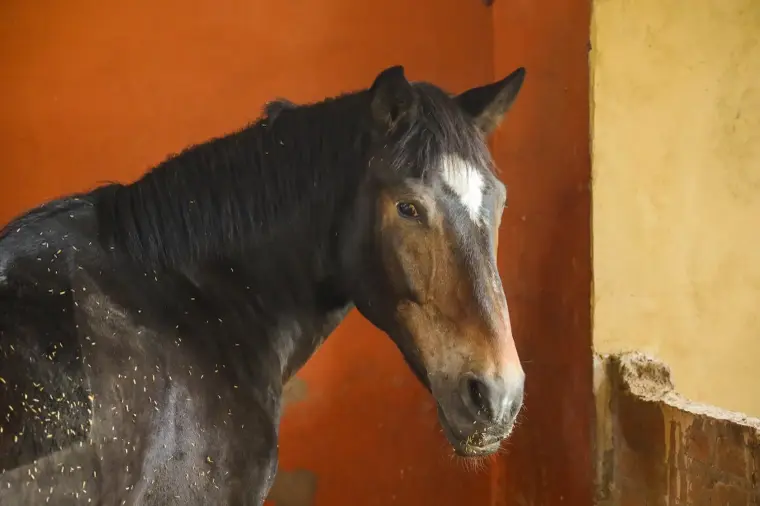
The photograph was taken a little after eight in the morning, in the doorway of a stable washed in terracotta and ochre. A dark bay horse stands with his head turned toward the light, ears forward, eye soft. His coat is scattered with rice hulls — pale flecks across the neck and shoulder, a few still caught in the whiskers of his muzzle. He has been down in his bedding, and not long ago.
In most yards, this frame would have been deleted before lunch.
The convention in equestrian photography is absolute. A horse is groomed before he is photographed, the way a room is tidied before guests arrive. Manes are combed, coats are polished with a stable rubber until they hold the light, hooves are oiled to a gloss no working hoof wears for long. The photograph that results is not dishonest, exactly. It is a portrait of preparation rather than a portrait of a horse.
At Vonfidel Ranch the photograph with the rice hulls in it went into the archive, and it has quietly become one of the most instructive images the ranch owns.
Consider what the hulls actually record. In this part of Sri Lanka the stalls are bedded on rice hulls, milled a few miles away in paddy country, and a horse wearing his bedding is a horse that has been lying down. Horses lie flat only where they feel safe enough to give up the option of flight; it is one of the few welfare measures that cannot be staged. Rolling, the great undignified pleasure of the species, leaves the same evidence. Every mark a groom’s brush removes is, read another way, a small welfare report written by the horse himself.
None of this is an argument against grooming. Grooming matters — for skin health, for the daily inspection of legs and back, and for the quiet conversation that happens when a person spends twenty minutes with their hands on an animal. The horses at Punanai are groomed every day. The argument is narrower and less comfortable: the industry has come to treat the groomed horse as the true horse and the ungroomed horse as an unfinished one, when the reverse is closer to the truth.
The tropics sharpen the point. In the dry-zone scrub of eastern Sri Lanka, dust is not an event but a medium. Horses turned out on cropped grass under a hard sky acquire a film of it within the hour, and they add to it deliberately, rolling in the warm earth the moment they are loosed. A photograph of a spotless horse in this landscape shows an animal that has just been prevented from behaving normally. Visitors sometimes arrive expecting the lacquered horses of the show ring and find animals that look faintly disreputable by four in the afternoon. It takes them a day or two to understand that they are looking at contentment.
There is a wider habit of mind at stake. The impulse to brush the horse before the camera comes out is the same impulse that straightens the tack room for the website and crops the feed buckets out of frame — the belief that a place must be presented rather than shown. Anyone who has spent time around real stables knows their texture: the hulls underfoot, the swallows, the smell of warm brick. Remove all of it and what remains photographs beautifully and persuades no one.
The horse in the doorway was brushed later that morning, as he is every morning. The photograph stayed as it was taken.
In most yards, this frame would have been deleted before lunch.
The convention in equestrian photography is absolute. A horse is groomed before he is photographed, the way a room is tidied before guests arrive. Manes are combed, coats are polished with a stable rubber until they hold the light, hooves are oiled to a gloss no working hoof wears for long. The photograph that results is not dishonest, exactly. It is a portrait of preparation rather than a portrait of a horse.
At Vonfidel Ranch the photograph with the rice hulls in it went into the archive, and it has quietly become one of the most instructive images the ranch owns.
Consider what the hulls actually record. In this part of Sri Lanka the stalls are bedded on rice hulls, milled a few miles away in paddy country, and a horse wearing his bedding is a horse that has been lying down. Horses lie flat only where they feel safe enough to give up the option of flight; it is one of the few welfare measures that cannot be staged. Rolling, the great undignified pleasure of the species, leaves the same evidence. Every mark a groom’s brush removes is, read another way, a small welfare report written by the horse himself.
None of this is an argument against grooming. Grooming matters — for skin health, for the daily inspection of legs and back, and for the quiet conversation that happens when a person spends twenty minutes with their hands on an animal. The horses at Punanai are groomed every day. The argument is narrower and less comfortable: the industry has come to treat the groomed horse as the true horse and the ungroomed horse as an unfinished one, when the reverse is closer to the truth.
The tropics sharpen the point. In the dry-zone scrub of eastern Sri Lanka, dust is not an event but a medium. Horses turned out on cropped grass under a hard sky acquire a film of it within the hour, and they add to it deliberately, rolling in the warm earth the moment they are loosed. A photograph of a spotless horse in this landscape shows an animal that has just been prevented from behaving normally. Visitors sometimes arrive expecting the lacquered horses of the show ring and find animals that look faintly disreputable by four in the afternoon. It takes them a day or two to understand that they are looking at contentment.
There is a wider habit of mind at stake. The impulse to brush the horse before the camera comes out is the same impulse that straightens the tack room for the website and crops the feed buckets out of frame — the belief that a place must be presented rather than shown. Anyone who has spent time around real stables knows their texture: the hulls underfoot, the swallows, the smell of warm brick. Remove all of it and what remains photographs beautifully and persuades no one.
The horse in the doorway was brushed later that morning, as he is every morning. The photograph stayed as it was taken.