
There is a speed at which the world begins to make sense again.
Not the pace of itineraries or schedules, nor the performative urgency of modern travel, but a quieter tempo — one governed by breath, balance, and attentiveness. On horseback, this pace reveals itself naturally. You cannot rush it without consequence. You cannot fake it. You must inhabit it.
At Vonfidel Ranch, riding is not treated as an activity layered onto a destination. It is the means by which the landscape introduces itself. The horse does not hurry the terrain, nor does the rider impose urgency upon the horse. Together, they move through land that has its own rhythms — waterlines, animal paths, wind corridors, and old human crossings that predate roads.
This is not nostalgia. It is literacy.
To ride well is to read the environment continuously: the softening of ground near water, the pause of wildlife at dusk, the way light alters distance and depth. These are not details noticed at speed. They are revealed only when one moves with restraint.
Civilization, in its earliest forms, understood this. Horses were not engines. They were partners. Trust was not sentimental — it was functional. Care was not indulgent — it was survival. The modern world, in forgetting this, has mistaken acceleration for progress.
What is offered here is not a correction, but a reminder.
A civilized pace does not reject modernity. It simply refuses to be dominated by it. It values precision over force, patience over volume, and presence over spectacle. In riding this way, one discovers that refinement is not something added to experience — it emerges when excess is removed.
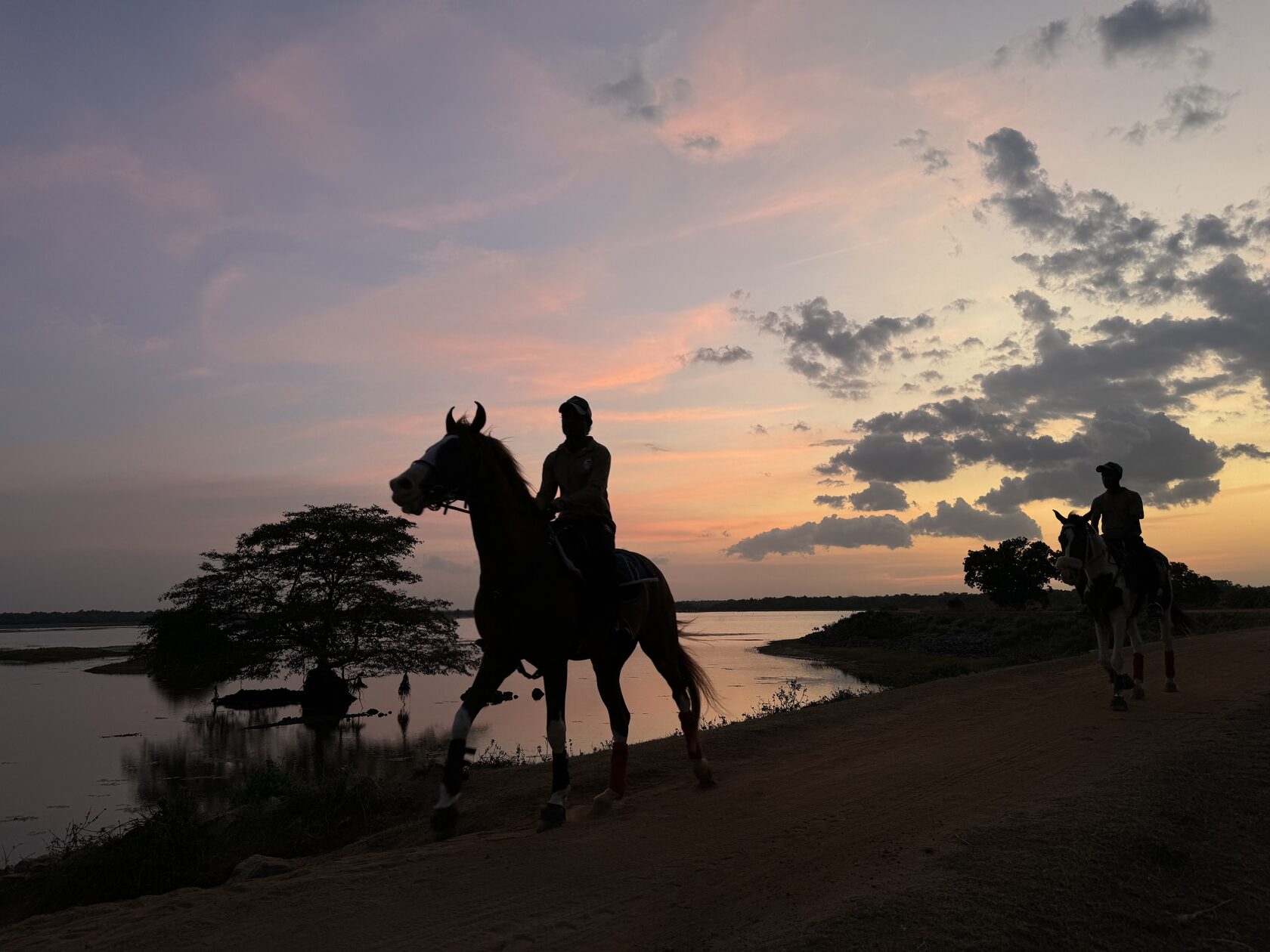
When evening arrives and the land exhales its heat, riders return without the sense of having “done” something. Instead, there is a quieter satisfaction: the feeling of having been properly placed within a moment, neither above it nor rushed through it.
This is the pace at which horses remain sound, landscapes remain legible, and riders leave with more than photographs.
It is not slow.
It is civilized.
Not the pace of itineraries or schedules, nor the performative urgency of modern travel, but a quieter tempo — one governed by breath, balance, and attentiveness. On horseback, this pace reveals itself naturally. You cannot rush it without consequence. You cannot fake it. You must inhabit it.
At Vonfidel Ranch, riding is not treated as an activity layered onto a destination. It is the means by which the landscape introduces itself. The horse does not hurry the terrain, nor does the rider impose urgency upon the horse. Together, they move through land that has its own rhythms — waterlines, animal paths, wind corridors, and old human crossings that predate roads.
This is not nostalgia. It is literacy.
To ride well is to read the environment continuously: the softening of ground near water, the pause of wildlife at dusk, the way light alters distance and depth. These are not details noticed at speed. They are revealed only when one moves with restraint.
Civilization, in its earliest forms, understood this. Horses were not engines. They were partners. Trust was not sentimental — it was functional. Care was not indulgent — it was survival. The modern world, in forgetting this, has mistaken acceleration for progress.
What is offered here is not a correction, but a reminder.
A civilized pace does not reject modernity. It simply refuses to be dominated by it. It values precision over force, patience over volume, and presence over spectacle. In riding this way, one discovers that refinement is not something added to experience — it emerges when excess is removed.
When evening arrives and the land exhales its heat, riders return without the sense of having “done” something. Instead, there is a quieter satisfaction: the feeling of having been properly placed within a moment, neither above it nor rushed through it.
This is the pace at which horses remain sound, landscapes remain legible, and riders leave with more than photographs.
It is not slow.
It is civilized.