
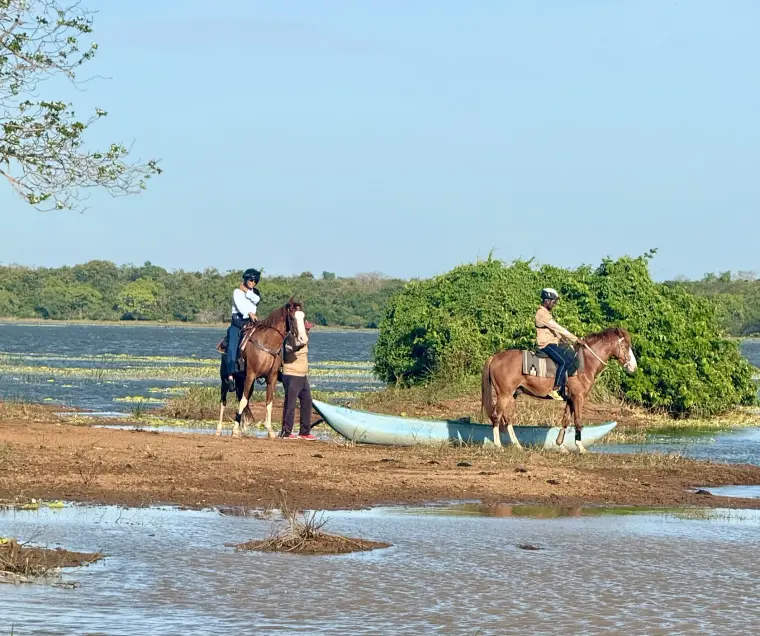
Punanai is tank country. The land around the ranch is stitched with old reservoirs and seasonal streams, and the low ground remembers rain long after the sky has cleared. Anyone can see the water here. The work of the estate is learning to read it.
On a working riding estate, water decides more than the map does. A route that was correct in February can be wrong in November for reasons that never appear on a chart. The chart shows where the water sits. It says nothing about what the water has been doing.
In the wet months, reading water is mostly a matter of reading ground. Standing water is honest and announces itself. The trouble sits at its edges, where the surface has dried into a crust while the mud beneath has not. Run-off carrying red earth means the ground upstream is moving. A hoofprint that still holds its shape three days after the last shower tells us how a trail will carry weight. Buffalo find soft ground before any rider does, and where they have churned a bank stays visible for weeks.
Crossings are their own discipline. A crossing is not judged by whether a horse can manage it on a good day. It is judged by whether the bottom can be read. Water that ran clear in the morning can carry silt by afternoon, and once the bottom disappears, so does the crossing. We have turned rides around within sight of the far bank for exactly this reason. The horse was willing. The water was no longer legible. The ride went another way.
In the dry months, the reading changes. Water becomes the quiet architecture of the day. Routes are shaped around where horses can drink and how far a horse should sensibly work between one reliable water point and the next. A horse at rest drinks upwards of thirty litres a day, and heat and work raise that figure quickly. In this climate, a route without dependable water is a poorly planned one, whatever else it offers.
The horses themselves are part of the instrument. A horse that hesitates at a familiar crossing is offering a report, and we treat it as one. So is a horse that declines to drink at a place it has drunk a hundred times. Sometimes the explanation is trivial. Sometimes the water has changed in a way we could not see from the saddle. Either way, the observation costs nothing to respect and a great deal to ignore.
None of this produces anything a guest would recognise as an event. A rerouted ride looks like an ordinary ride that happened to go somewhere else. A crossing declined looks like nothing at all. That is acceptable. The value of this work lies in what it quietly removes from the day.
The tanks were built by people who understood this country’s relationship with water better than most modern maps do. We ride through their arithmetic every day. The least we can do is keep learning it.
Alfie Ameer, Vonfidel Ranch