
In 1990, Christopher Ondaatje travelled back to the country of his birth to visit a village whose name, where it was known at all, meant one animal. The leopard of Punanai had killed more than twenty people in the early part of the last century, and its legend outlived everyone involved. Ondaatje went in pursuit of two ghosts, the leopard and his own father, and the book that came out of the journey, The Man-Eater of Punanai, is only partly about a predator. It is a study of fear, and of what it costs a man to walk toward the thing that frightens him.
The book gave this corner of eastern Sri Lanka its place in travel literature. What it could not have predicted is who would be reading the landscape three decades later.
Vonfidel Ranch stands on the eastern edge of the Punanai outback, and the animals that know this country most intimately today are horses. That is a stranger fact than it first appears. A horse is the most refined prey animal ever brought into partnership with people. Its eyes sit on the sides of its skull and sweep nearly the full circle of the horizon. Its ears move independently, cataloguing sound the rider never registers. It reads wind, ground vibration, the behaviour of birds, and the posture of every creature within sight. Millions of years of being hunted built an animal that audits its surroundings constantly and involuntarily. A horse cannot be persuaded that a place is safe. It can only conclude so, on its own evidence, day after day.
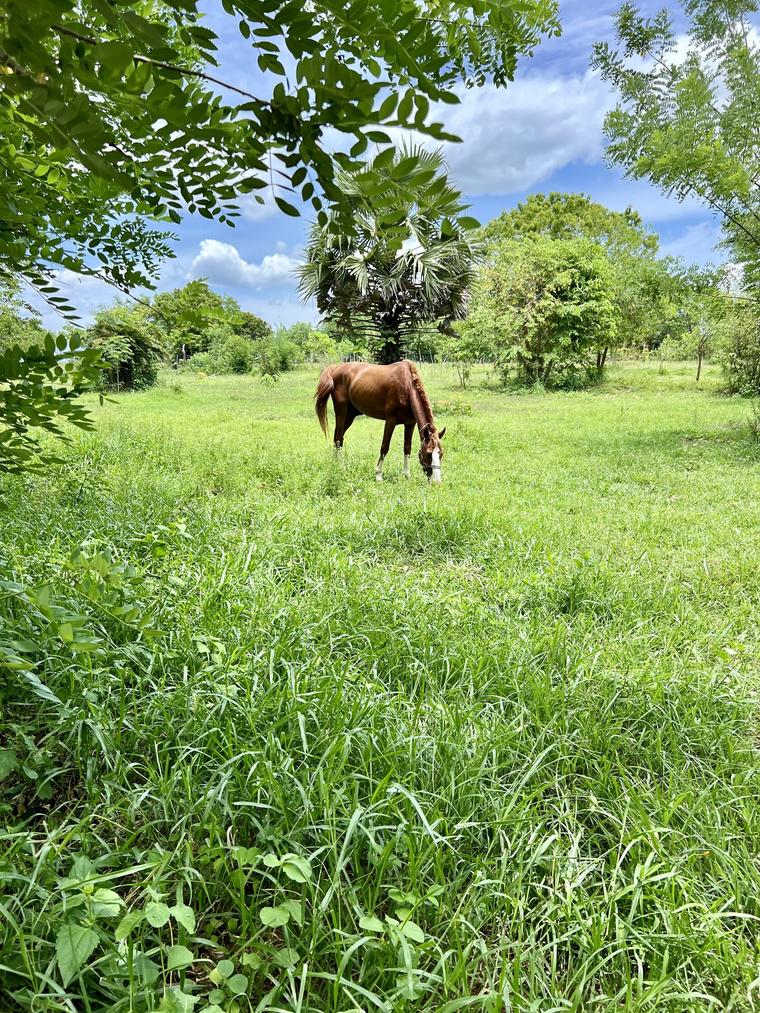
This is what makes the calm of the Punanai horses a kind of verdict. The village that entered literature through terror is now measured each morning by the composure of animals designed to detect exactly the sort of danger that made it famous. When a Marwari mare grazes flat-footed at dusk, hip cocked, ears loose, she is not performing calm. Horses do not perform. Her posture is a continuous, unedited report on the land: the scrub, the seasonal water, the open grazing country, the treeline where the light goes first. Leopards still move through eastern Sri Lanka, and the horses know it long before any person does. Their steadiness is awareness that has been answered, night after night, by nothing going wrong.
The ranch takes no credit for the first part of that equation. The land is what it is. The second part is the work. A prey animal’s confidence in a place is inseparable from its confidence in the people who keep it there. A horse that is worked past soundness, handled inconsistently, or startled for entertainment carries that history in its body, and it spends its attention on the humans instead of the horizon. The welfare doctrine that governs Vonfidel Ranch exists, in part, for this reason. Controlled workloads, structured rest, consistent handling, and the discipline to cancel a ride when conditions argue against it are the conditions under which a horse can afford to relax in open country. A relaxed horse in open country is the only honest advertisement a riding estate can offer.
There is a quiet irony in the breeding. The horses here are Marwari and Sindhi, desert horses from the arid northwest of the subcontinent, shaped by scarcity, heat, and long sightlines. They were not made for monsoon country, and their adaptation to it has been gradual and carefully managed. Yet their desert inheritance suits Punanai in one respect. These are breeds that evolved to survey enormous distances and decide, from far off, what deserves worry. Put such an animal in country with real predators and its judgment sharpens rather than frays. The rider feels this as a particular quality of attention under the saddle, forward and untroubled. Guests sometimes describe it as the horse feeling switched on. What they are feeling is a prey animal doing its oldest work, and finding the answer acceptable.
Ondaatje’s journey ended at Punanai with a reckoning rather than a trophy. He found the village diminished by war, the leopard long dead, and his father understood a little better than before. The fear he had carried was examined and, in some measure, set down. That arc is worth keeping in mind on horseback here, because a ride through this country retraces it in miniature. The rider arrives with whatever the word leopard summons. The horse, hour by hour, offers a counter-argument made of loose ears and an even stride through the scrub. By the time the light drops and the ranch comes back into view, most riders have absorbed the horse’s reading of the place without noticing the transfer.
The leopard made Punanai famous by taking lives. The book returned to the fear and took it seriously. The horses now add a third account, delivered without language and renewed every day: the testimony of animals that cannot lie about where they are, grazing calmly in the country the man-eater once ruled.
The book gave this corner of eastern Sri Lanka its place in travel literature. What it could not have predicted is who would be reading the landscape three decades later.
Vonfidel Ranch stands on the eastern edge of the Punanai outback, and the animals that know this country most intimately today are horses. That is a stranger fact than it first appears. A horse is the most refined prey animal ever brought into partnership with people. Its eyes sit on the sides of its skull and sweep nearly the full circle of the horizon. Its ears move independently, cataloguing sound the rider never registers. It reads wind, ground vibration, the behaviour of birds, and the posture of every creature within sight. Millions of years of being hunted built an animal that audits its surroundings constantly and involuntarily. A horse cannot be persuaded that a place is safe. It can only conclude so, on its own evidence, day after day.
This is what makes the calm of the Punanai horses a kind of verdict. The village that entered literature through terror is now measured each morning by the composure of animals designed to detect exactly the sort of danger that made it famous. When a Marwari mare grazes flat-footed at dusk, hip cocked, ears loose, she is not performing calm. Horses do not perform. Her posture is a continuous, unedited report on the land: the scrub, the seasonal water, the open grazing country, the treeline where the light goes first. Leopards still move through eastern Sri Lanka, and the horses know it long before any person does. Their steadiness is awareness that has been answered, night after night, by nothing going wrong.
The ranch takes no credit for the first part of that equation. The land is what it is. The second part is the work. A prey animal’s confidence in a place is inseparable from its confidence in the people who keep it there. A horse that is worked past soundness, handled inconsistently, or startled for entertainment carries that history in its body, and it spends its attention on the humans instead of the horizon. The welfare doctrine that governs Vonfidel Ranch exists, in part, for this reason. Controlled workloads, structured rest, consistent handling, and the discipline to cancel a ride when conditions argue against it are the conditions under which a horse can afford to relax in open country. A relaxed horse in open country is the only honest advertisement a riding estate can offer.
There is a quiet irony in the breeding. The horses here are Marwari and Sindhi, desert horses from the arid northwest of the subcontinent, shaped by scarcity, heat, and long sightlines. They were not made for monsoon country, and their adaptation to it has been gradual and carefully managed. Yet their desert inheritance suits Punanai in one respect. These are breeds that evolved to survey enormous distances and decide, from far off, what deserves worry. Put such an animal in country with real predators and its judgment sharpens rather than frays. The rider feels this as a particular quality of attention under the saddle, forward and untroubled. Guests sometimes describe it as the horse feeling switched on. What they are feeling is a prey animal doing its oldest work, and finding the answer acceptable.
Ondaatje’s journey ended at Punanai with a reckoning rather than a trophy. He found the village diminished by war, the leopard long dead, and his father understood a little better than before. The fear he had carried was examined and, in some measure, set down. That arc is worth keeping in mind on horseback here, because a ride through this country retraces it in miniature. The rider arrives with whatever the word leopard summons. The horse, hour by hour, offers a counter-argument made of loose ears and an even stride through the scrub. By the time the light drops and the ranch comes back into view, most riders have absorbed the horse’s reading of the place without noticing the transfer.
The leopard made Punanai famous by taking lives. The book returned to the fear and took it seriously. The horses now add a third account, delivered without language and renewed every day: the testimony of animals that cannot lie about where they are, grazing calmly in the country the man-eater once ruled.
Further at the Ranch: About Our Horses and Trail Rides.